ServicesDual Tank Filtration
Norwalk Dual Tank Water Filtration
A dual tank system goes in at the point where water enters your house and treats it before any faucet gets it. Our licensed plumbers pick the right size for your household, put it in neatly and show you how it works. The kitchen, shower and laundry all get better water.
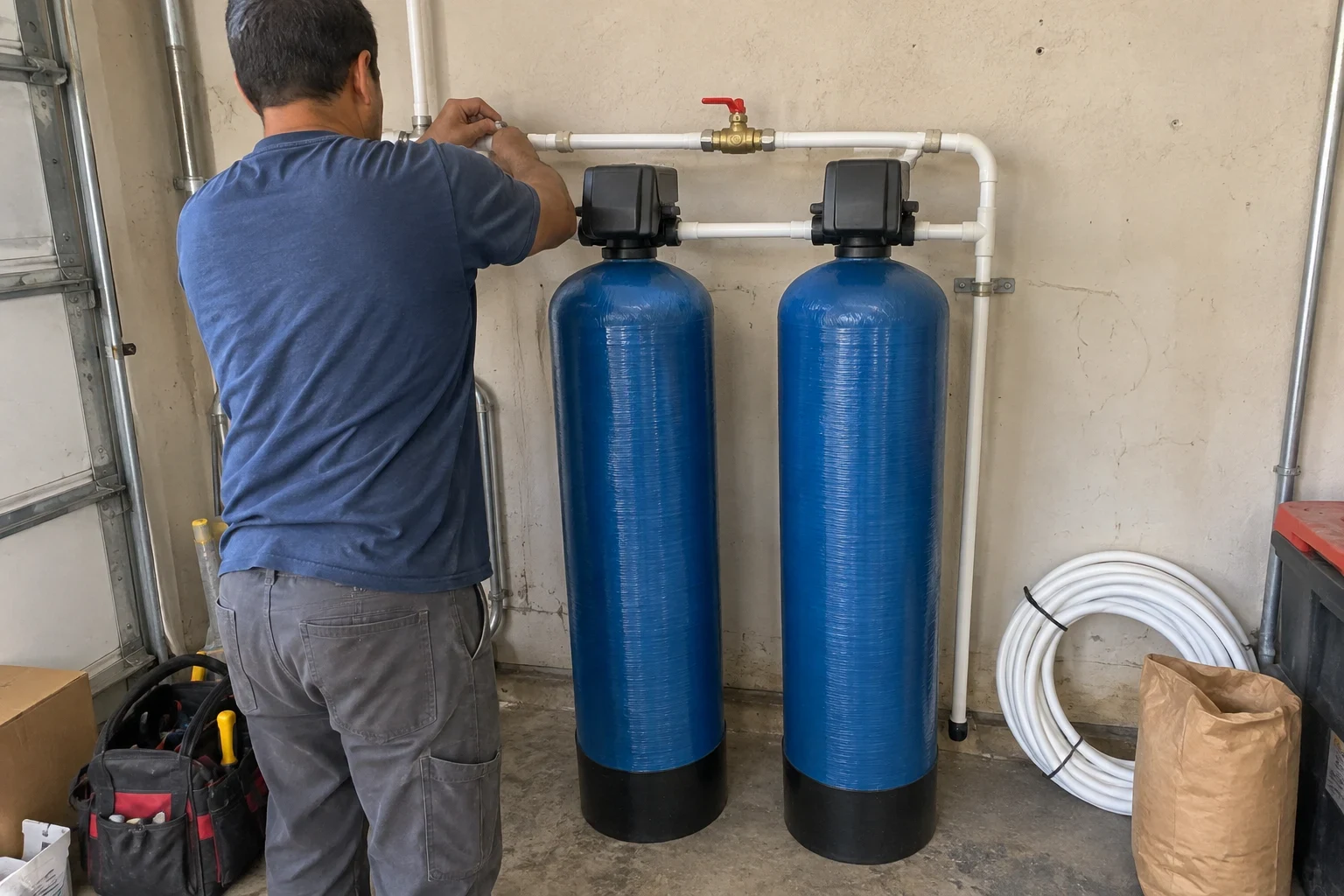
What a Dual Tank System Does
A dual tank system uses two tanks side by side. One holds the filter media that the water passes through. The other holds salt, which the system uses on a set schedule to rinse and refresh that media so it keeps working.
Because it treats water at the main line, you are not changing cartridges under every sink. It suits homes where people notice the water everywhere, not just in a glass. If you only want better drinking water at one faucet, reverse osmosis at the kitchen sink may be the simpler fit, and we will tell you so.
We work in Norwalk and nearby towns like Downey, Bellflower and La Mirada. We do the job the way we would want it done in our own house: tidy, explained and finished properly.
What You Get With the Install
- A system sized to your home
- We ask how many people live with you, which fixtures you use and when the water runs hardest. Then we choose tanks big enough to keep up without hurting your pressure.
- A clean tie-in at the main line
- Our licensed plumbers in California make the connection at your main line with proper fittings. We also put in a bypass valve, so water can be routed around the system whenever it needs service.
- Free install
- The install is free, and we cover that cost ourselves. Your money goes toward the equipment, and the labor is on us.
- Salt in the tank on day one
- We add free salt to the tank as part of the install. That way the system can run its first cycle before we pack up.
- Leak checks before we go
- After the water is back on, we watch each joint and the drain line through one full cycle. We do not call it done until everything stays dry.
- A walkthrough and cleanup
- We point out the bypass and the control head and show you how to add salt. Then we clean up the work area and haul away our boxes.
Signs a Dual Tank System Makes Sense
Chlorine smell in the shower
If you notice that pool smell when the hot water runs, it is not just the kitchen tap. Treating at the main line reaches every fixture.
Spots on glasses and fixtures
White marks on dishes, faucets and shower glass come from what is dissolved in the water. Many people in Southern California see this, and it is a common reason to ask about a two-tank setup.
You are tired of swapping small filters
Pitcher filters and faucet attachments add up and need frequent changes. One system at the main line cuts that routine down.
Every faucet has the same off taste
If water from the bathroom tap is just as unpleasant as the kitchen, a single faucet filter will not solve it. Treating the water where it enters your home will.
You are already replumbing or remodeling
If walls are open or the water heater is being replaced, it is a good time to set up the main line for a system.
How the Job Goes
- 1
A phone conversation
You tell us what bothers you about the water and share a few details about your home. We give you a straight answer on whether a dual tank system fits or whether something smaller would work.
- 2
Sizing up the install spot
We locate where water comes into your home, check the pipe size and measure the space. A garage, side yard or utility closet is fine if there is room and a drain close enough to reach.
- 3
Install day
We close the main valve, set the tanks in place and plumb them in with a bypass, then hook up the drain line. Water to your home stays off only for the time those connections take.
- 4
Startup and walkthrough
We load the salt tank, start the first cycle and look for leaks. Before we leave, we show you how to read the control head and when it is time to add salt.
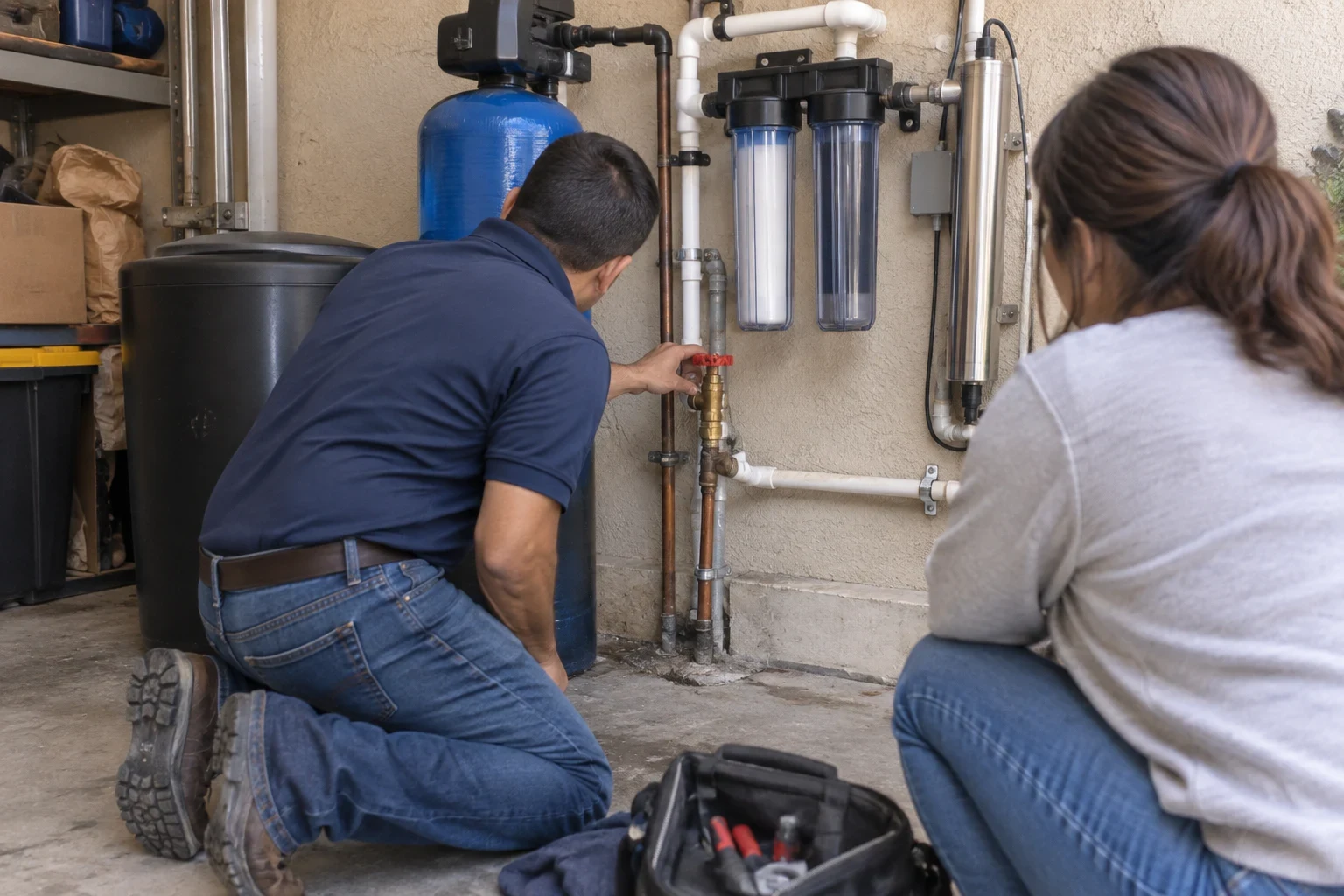
What Moves the Price
The install is free because we cover that cost, so most of what you pay is the system itself. We go through each line with you on the phone, so nothing new turns up on install day. These are the things that change the number.
- Tank size
- More bathrooms and more people mean more water moving at once. That calls for bigger tanks so flow keeps up. A smaller household can get by with a smaller system.
- Location of the water line
- If the pipe coming into your home is out in the open, say along a garage wall, hookup is quick. If it runs through a cramped spot, we may need extra pipe and fittings to bring it to a workable place.
- Condition of your pipes
- Older galvanized pipe at the tie-in point sometimes has to be swapped out first. If we see that, we show you and explain why before any work starts.
- Drain access
- During each rinse cycle the system sends water to a drain. When there is no drain close by, we run a line to the nearest one.
Dual Tank Questions
Something not covered here? (562) 456-0392
Why two tanks instead of one?
The first tank holds the media your water runs through. The second holds salt, which the system draws on during scheduled rinse cycles to clean and recharge that media. Splitting the jobs keeps refills easy and helps the media last longer.
How often do I add salt?
It varies with the size of your household and how much water you use day to day. Lift the lid on the salt tank every few weeks and check the level. When it gets low, pour in another bag. On install day we fill it for you, so you start out full.
Will it lower my water pressure?
Not if the tanks match your home. That is why we ask about your bathrooms, fixtures and busiest times of day before we pick a size.
Is this the same as reverse osmosis?
No. Reverse osmosis goes under the kitchen sink and cleans drinking water at that one faucet. A dual tank system handles all the water that comes into your home. Some families run both.
What does the warranty cover?
All of our units carry a free 3-year warranty. On install day we walk you through what it covers, so there are no questions later.
Let's Talk It Through
Describe your home and what you're seeing in your water. We'll give you a plain answer on whether a dual tank system suits it and what the job would involve.